Solutions · Fire & Rescue
Built for the chief who has to plan five years out and defend it tonight.
Capital Command connects what your department needs — apparatus, equipment, SCBA/PPE, stations, personnel — with how you're going to pay for it, and helps you make the case to your board or council. This is Capital Command's primary, production-ready market: purpose-built for fire and EMS, not government software with a fire-service skin.
What do we need? When do we need it? What will it cost? How do we fund it? How do we make the case?
Every fire chief already answers versions of these questions, department by department, apparatus by apparatus. Capital Command gives those answers one home — connected to each other, not scattered across spreadsheets, grant websites, email threads, and institutional memory.
Apparatus & Fleet
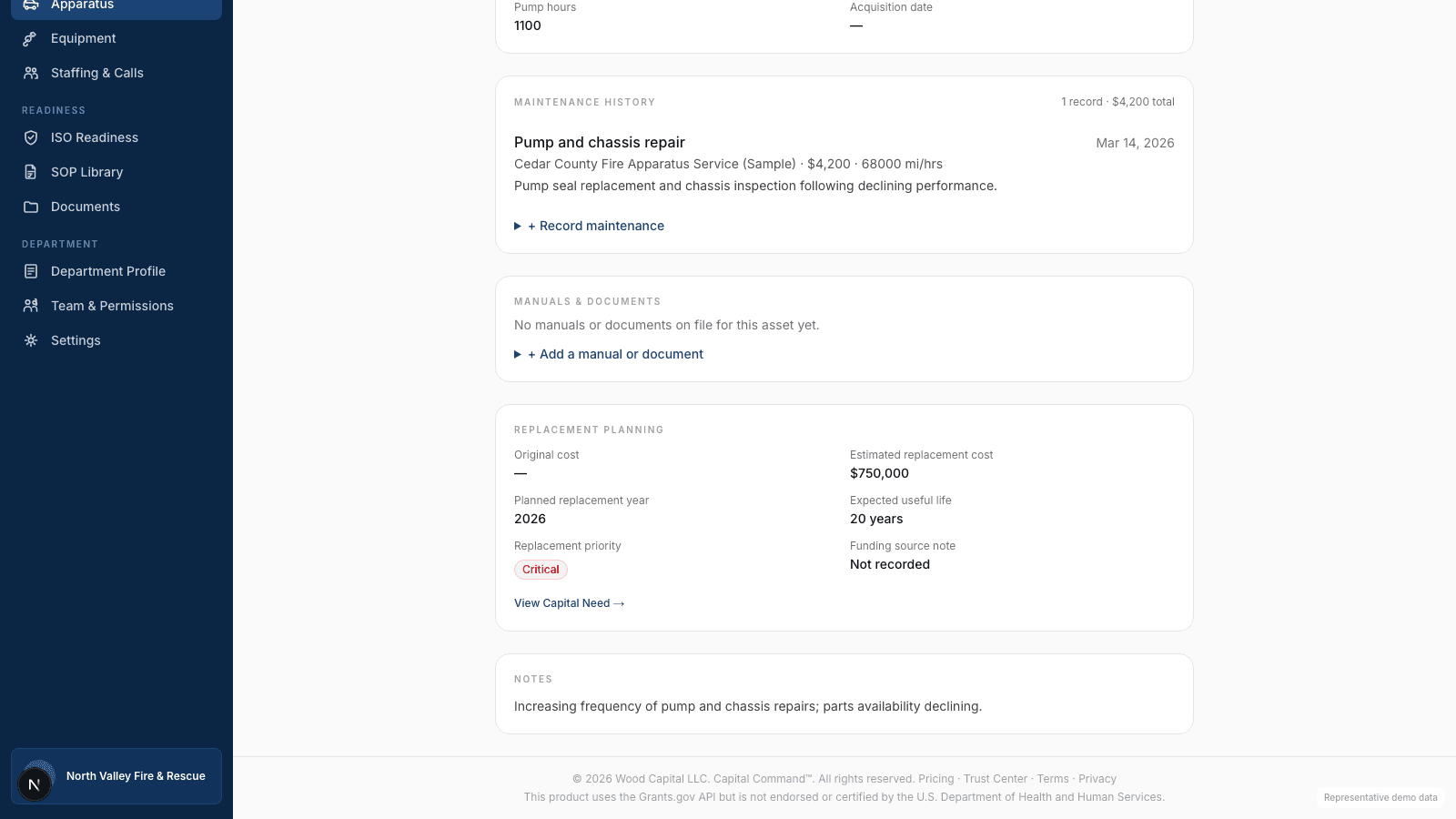
Every engine, ladder, tanker, and support vehicle with its own record: maintenance history, projected replacement year, estimated cost, and useful life — linked directly to its capital need.
Equipment, SCBA & PPE
Equipment and PPE inventories, including SCBA, tracked toward replacement the same way apparatus is — not a separate spreadsheet with its own aging schedule nobody checks.
Stations & Facilities
Facility capital needs — roof, apparatus bay, HVAC, a station addition — documented alongside apparatus and equipment needs in the same capital plan, not a separate binder.
Personnel & Staffing
Staffing information that feeds ISO/PPC preparedness and multi-year planning, so personnel needs are part of the capital conversation, not left out of it.
Replacement Forecasting
Apparatus and equipment records project forward into a replacement window and estimated cost, so a fleet's aging assets become planned capital needs years before they become emergencies.
Capital Planning
Documented needs and projected replacements organized by year, cost, and funding status — the same multi-year picture, kept current, instead of a spreadsheet nobody updates.
Funding Discovery & Funding Intelligence
Capital Command evaluates a need against relevant funding opportunities across federal, state, regional, local, private, corporate, and foundation sources, and shows its reasoning for each potential match.
Applications
Each funding match has its own application workspace: what's missing, what's drafted, and its current status — tracked from pursued through secured.
Budgeting
Annual operating and capital budgeting (Budget Builder, Professional and above) tied to the same needs and apparatus records already in the system.
Leadership Reporting
Secured, pending, and potential funding for every project roll up into one report built for a board, council, or finance-committee conversation.
Apparatus & Equipment
Every apparatus keeps its history — and its funding status.
Maintenance history, replacement window, estimated cost, and a direct link to the capital need it feeds — all on the same record, not scattered across binders and someone's inbox.
ISO/PPC Preparedness
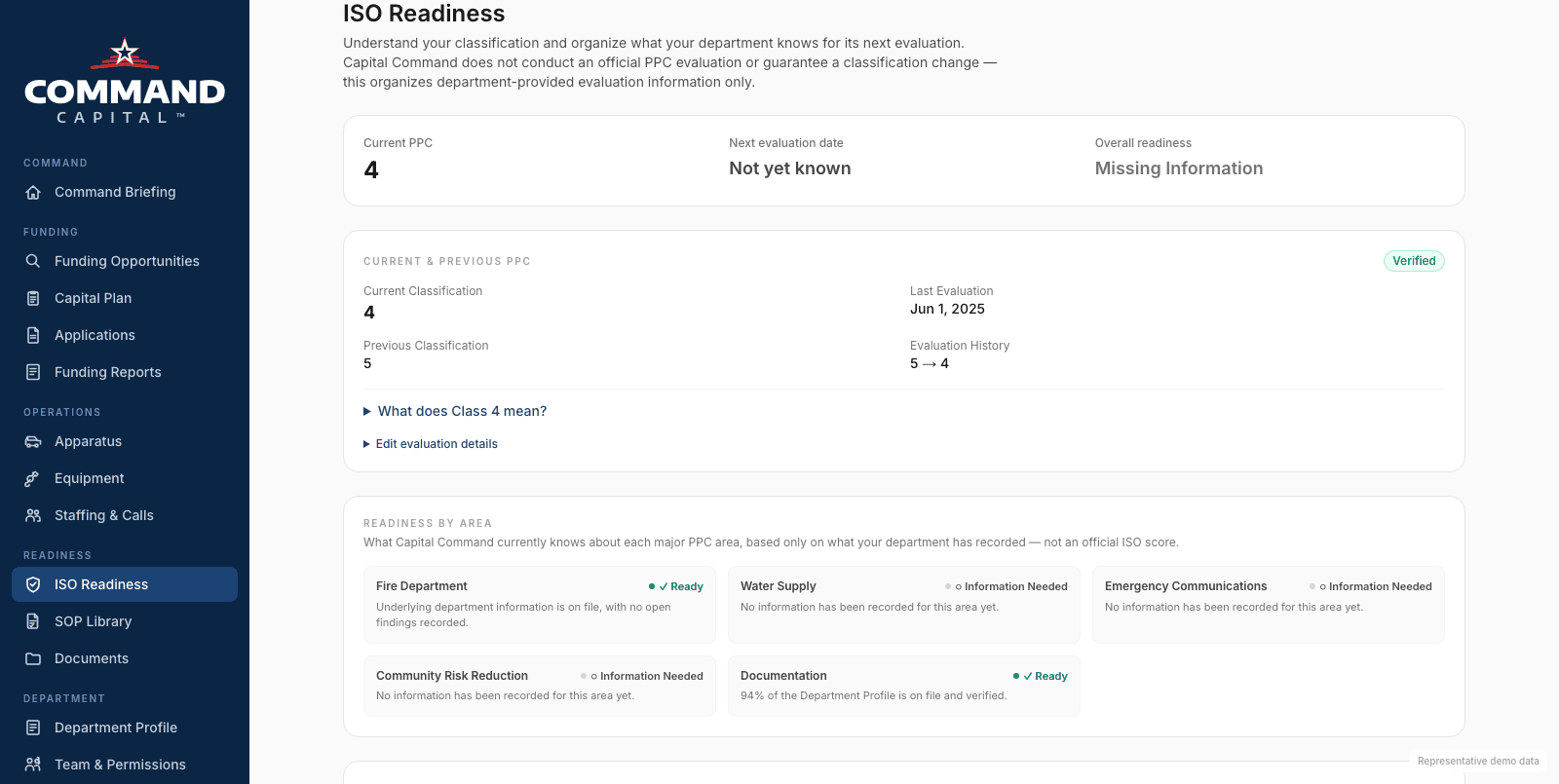
Know your classification. Organize what's ready.
Capital Command helps you track and organize the staffing, apparatus, and department information relevant to ISO/PPC, by area, so it's in one place ahead of your next evaluation.
Capital Command does not conduct an official ISO/PPC evaluation and does not guarantee a classification change. That determination is made by ISO or the relevant rating authority, not by this software.
Funding Intelligence
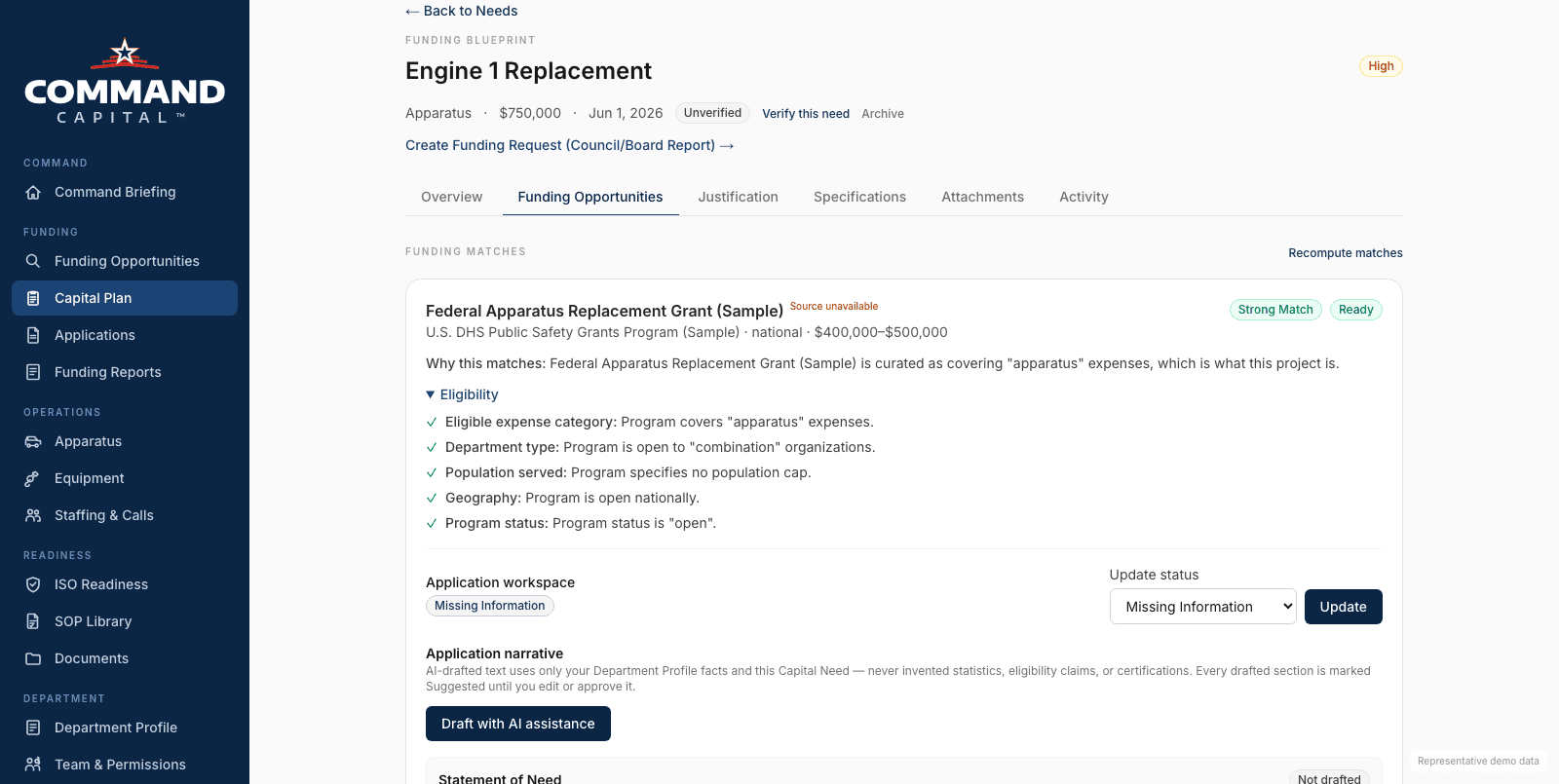
Stop searching grants. Start seeing the ones that fit this apparatus.
Matches are evaluated against your department's actual, documented need, with reasoning shown — not a keyword search across a generic grant database.
Potential, strong, or requiring review — always a starting point for judgment, never a guaranteed award.
What Capital Command is not.
Capital Command isn't your RMS, CAD, dispatch, scheduling, payroll, accounting, ERP, inspection, pre-plan, fleet-maintenance, HR, work-order, or inventory system. Those systems help run today's department. Capital Command helps leadership plan tomorrow's department — capital needs, replacement planning, funding, and the case you bring to your board or council — and is designed to sit alongside your existing operational tools, not compete with or replace them.